How to Choose a Trustworthy Mover in Jeddah and Avoid Scams
Most moving problems are not bad luck but gaps that can be closed before you sign. This guide explains the recurring tactics in the market and how to protect yourself with a few simple steps.

Where is the gap that gets exploited in moving?
The essential vulnerability in this service is that payment happens after your possessions are already in someone else's hands. Once your household is loaded into a truck, your bargaining position is at its weakest: you cannot withdraw, you cannot switch to another company, and you cannot even argue at length because your day is tied to handing over one property and taking possession of another. Anyone who wants to exploit that knows it well, which is why most poor practice concentrates at exactly that moment: asking for extra money after loading on the grounds that the volume is larger than expected, the floor is higher, or the work took longer. Protecting yourself is not a matter of vigilance on the day — by then it is too late — but of closing the gap days earlier with three simple steps: a survey before quoting, a written itemised quote, and photographic documentation of your belongings before loading. A company that refuses all three is telling you something about its intentions before any work begins.
Four steps that protect you in practice
Simple actions that take minutes and close most of the gaps:
Insist on a survey before committing
A survey — on site or by video — is what turns a price from an estimate into a commitment. A company that has seen your belongings has no grounds to raise the price later; one that refused to look has deliberately kept that argument available.
Get a written, itemised quote
Not a lump sum but a breakdown: transport and labour, dismantling and reassembly, packing, special services, and what the price explicitly excludes. A documented WhatsApp message is sufficient legally and practically; you do not need a formal contract.
Photograph the condition of your belongings
Before loading begins, photograph the main items and appliances and their serial numbers. It takes ten minutes and converts any later discussion from one word against another into a documented comparison. A serious company does this itself and welcomes you doing it.
Do not pay in full before the work is finished
The accepted arrangement is a small deposit to hold the date with the balance on completion after you have inspected the result. Paying in full up front removes any incentive to finish well and leaves you with no leverage at all.

The most frequent tactics in the moving market
Knowing them in advance removes their effect, because most rely on surprise.
The first and best known: an attractively low phone quote followed by a price increase after loading. The second: vague pricing that says “everything is included” with no detail, after which dismantling, packing and hoisting turn out to be extras. The third: day labour assembled on the morning of the move but presented as the company's permanent crew. The fourth: borrowed photographs of trucks and crews the company does not own. The fifth: demanding a large advance payment before any survey or agreement. The sixth: a verbal guarantee mentioned only as a general promise and never honoured when needed. The seventh: fabricated reviews posted together in similar wording. Each of these has a simple countermeasure, and most collapse the moment you ask for written documentation.
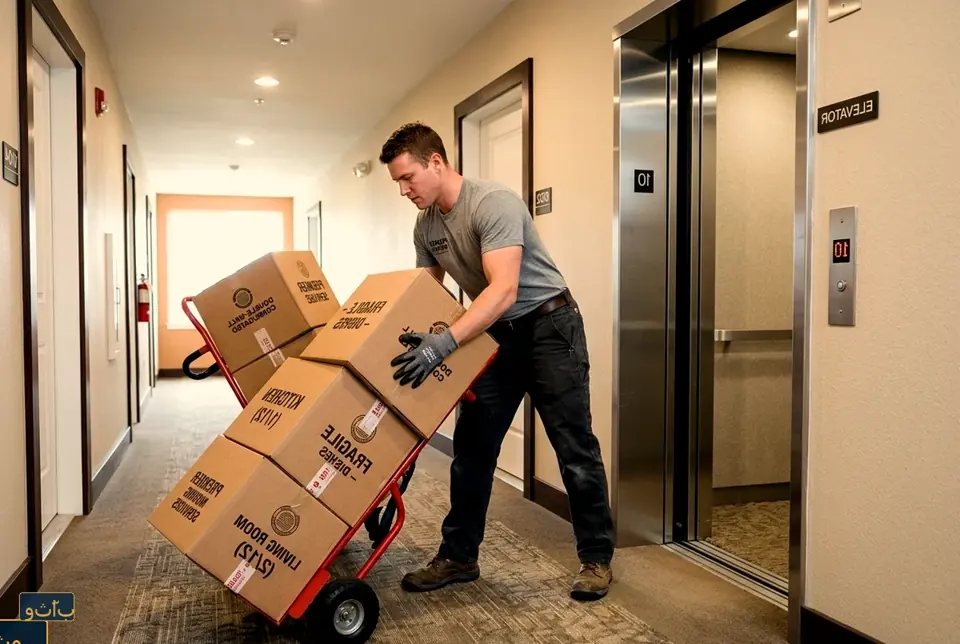
Warning signs and the matching protective step
A practical table: if you see the sign, take the matching step before you commit:
| Warning sign | What it usually means | Protective step |
|---|---|---|
| Refusing a survey, insisting on a phone price | Keeping the right to change the price later | Insist on a survey, even by video, before committing |
| Refusing to send a written itemised quote | No intention of being held to a figure | Do not book before a written quote arrives |
| A price far below three other quotes | Excluded items or a later increase | Ask directly: what does the price not include? |
| Demanding a large advance with no agreement | Direct financial exposure | A small deposit only, balance on completion |
| No commercial registration or known address | No entity to refer back to | Ask for the registration and invoice capability |
| A verbal guarantee with no written terms | It will not be honoured when needed | Request the guarantee terms in writing before booking |
| All five-star reviews in similar wording | Manufactured reviews | Look for average reviews and the company's replies |
| Pressure to decide immediately | Preventing comparison and reflection | Do not decide under pressure — moving is a scheduled service |
| Refusing to record item condition before loading | Avoiding proof of liability | Photograph and document it yourself before loading |
One warning sign does not necessarily indicate bad faith, but it does call for a question and an explanation. Three or more together is sufficient reason to look elsewhere however attractive the price.
What to do if a problem actually arises
Specific steps if you are asked for extra money or something is damaged:
Do not pay under pressure immediately
If you are asked for a sum that was never agreed after loading, do not pay straight away and do not get into a confrontation. Ask for a specific written reason for the increase; simply requesting documentation stops many of these attempts.
Document the situation at once
Photograph or record what is happening and keep a copy of the original agreement — the WhatsApp message or written quote — within reach. Documenting at the moment is far stronger than trying to establish it afterwards.
Refer back to the written agreement
Show the written quote or the message that set the price and the inclusions. In most cases the discussion ends there, because the existence of a document makes pursuing the demand difficult and pointless.
Ask to speak to someone senior
If it continues, ask for the owner or the responsible manager rather than dealing only with the driver or site supervisor. Many of these attempts are individual initiatives by a worker rather than company policy.
Ask for the load to be unloaded if necessary
If the other side insists on a sum that was never agreed, you are entitled to refuse to proceed and to ask for your belongings to be unloaded where they are. Stating that option calmly usually restores the balance on its own.
File a documented complaint
If damage occurs or an improper demand is made, you can complain through the official consumer protection channels supported by your documents: the written quote, the photographs and the correspondence. Documents are what make a complaint effective.
Understanding the moving market more deeply
Why these problems arise at all, and how to read the market with clear eyes.
Why low phone quoting is so widespread
The cause is economic rather than purely ethical. Most customers begin with a single question — how much? — and compare figures stripped of context. In a market where the product is compared on one number alone, the company quoting the lowest figure wins regardless of whether it can deliver at that price. A company that answers honestly with “between five hundred and nine hundred depending on the survey” appears more expensive than one that says “four hundred” while knowing the real figure is seven hundred and intending to ask for the difference after loading. The market therefore punishes honesty and rewards optimistic quoting. That is why everyone — customers and serious companies alike — benefits when comparison shifts from bare figures to itemised lines. Ask about the lines rather than the total and the rules change in your favour.
How to tell permanent crews from day labour
The difference shows in the first hour of work before you need to ask. A permanent crew arrives in uniform with the company's own equipment, each member knows their role without detailed instruction, there is a clear supervisor assigning tasks, and they begin by laying protective coverings over floors and hallways automatically because it is routine for them. Day labour assembled on the morning of the move arrives in mixed clothing, waits for instruction at every step, does not know the company's procedures because it does not work for the company, and ignores property protection because nobody told them. You can also ask directly beforehand: how many workers will attend and who is the responsible supervisor? An organised company answers with names and numbers; others answer in generalities. This does not mean every day labourer is poor, but the absence of institutional accountability means any error will have nobody to answer for it.
Photographic documentation: the simplest and most neglected protection
Ten minutes of photography before loading settles most potential disputes before they arise. Photograph the main items from several angles with close-ups of any existing scratch or defect — this protects you from being blamed for old damage and protects the company from a claim for damage it did not cause, which is fair to both. Photograph the appliance serial numbers, and photograph the load inside the truck once loaded. Most importantly, the photographs carry an automatic date and time in your phone, which is what makes them evidence rather than assertion. Watch the company's reaction when you start photographing: a serious one welcomes it and may already have done the same, and anyone irritated by documentation is telling you something important about themselves before the work begins.
When is a low price genuinely legitimate?
Not every low quote is an attempted swindle, and this matters so that you do not overpay out of fear. There are entirely legitimate reasons for a lower price: a small company with lower overheads and administration costs; a narrow geographical service area that reduces travel cost; a return leg that would otherwise run empty, where any revenue covers part of a cost already incurred; a slack season when prices naturally soften; or a basic service without extras that suits someone who does not need the extras. The difference between a legitimate discount and something else is simple: a company with a legitimate reason can explain it clearly and confidently when asked, while one hiding something will deflect or answer vaguely. So always ask, without embarrassment: “why is your price two hundred riyals lower than the others?” The answer itself is the test.
What your written agreement should contain
You do not need a complex legal contract; a clear WhatsApp message is sufficient practically and legally if it contains six elements. First: the final price broken down by line rather than a lump sum. Second: what the price explicitly excludes — hoist, storage, extra materials, waiting hours. Third: the date with approximate arrival time and expected duration. Fourth: the number of crew and the type of vehicle. Fifth: the guarantee terms — what it covers, how an item's value is assessed, and within how many days it is honoured. Sixth: the name and number of the person responsible for your job on site. Ask for these six in a single message before booking and keep it. A serious company will send it within minutes, and anyone who stalls over it has told you what you need to know.
Checklist before signing up
Four things you should hold before booking:
A written, itemised quote
Showing each service separately and stating explicitly what is excluded. This document is your sole reference if things change on the day, and without it every line becomes negotiable at the worst possible moment.
Written guarantee terms
What it covers, how a damaged item's value is assessed, within how many days compensation or repair happens, and what document records the condition of items before the move. Written answers, not verbal assurances.
The site supervisor's name and number
A named person responsible for your job with authority to decide, not a general reception line. When a quick decision is needed on the day you need the person who can make it.
Your own photographs of your belongings
Photograph the main items and appliances and their serial numbers yourself before loading starts. Ten minutes turns any potential dispute into a documented comparison with date and time.
Habits that leave you exposed
Common behaviours that open the door to problems:
Relying on a verbal agreement
What is not written cannot be relied upon, and every undocumented point becomes negotiable on the day when your position is weakest. One message summarising the agreement takes two minutes and removes all of it.
Paying the full amount in advance
Paying in full before the work removes any incentive to complete it well and strips you of your only leverage. No serious company requires it; a modest deposit to hold the date is the normal arrangement.
Ignoring warning signs because of the price
“The price is very low so I will overlook their refusal to document anything” is where most problems begin. The signs appear before you commit and are visible; ignoring them over a two-hundred-riyal saving can cost many times that.
Not reading reviews critically
A page of five-star reviews in similar wording posted within days of each other is a warning sign, not evidence of quality. Look for the average reviews and for how the company replied; its reply to one complaint is more honest than fifty compliments.
Further ways to protect yourself
Small details that reveal a great deal and save you trouble.
Test their responsiveness before committing
Send a detailed question and observe: how long was the reply? Did it actually answer the question or evade it? Was the tone respectful? How a company deals with you before payment is the best available indicator of how it will deal with you afterwards; one that stalls before taking anything will not become quicker once the job is done.
Ask about a problem they have actually faced
“Tell me about a problem you encountered on a previous job and how you handled it.” The question seems incidental but is revealing: a genuinely experienced company has real incidents and real solutions, while one claiming to have never had a problem is either new or not being candid.
Do not book at the last minute
Booking a day or two ahead removes your ability to compare or negotiate and forces you to accept whatever is available on any terms. Most people who run into trouble share the fact that they booked under pressure at the last minute. Book at least two weeks ahead.
Frequently asked questions about choosing a trustworthy mover
Practical answers on protecting yourself before and during a move:
Refusing to document anything: no written quote, no guarantee terms, no record of item condition. A company that refuses to document anything is keeping itself free to change everything later, and that alone is reason enough to look elsewhere.
Do not pay immediately under pressure. Ask for a specific written reason, document the situation with photographs, produce the original written agreement and ask to speak to someone senior. If they persist you are entitled to refuse and ask for your belongings to be unloaded.
No. It may have a legitimate cause: a small company with lower overheads, a return leg that would otherwise run empty, a slack season, or a basic service without extras. The difference is that a company with a legitimate reason explains it clearly when asked.
A clear WhatsApp message is sufficient in practice if it includes the itemised price, the exclusions, the date, the crew size and vehicle type, the guarantee terms and the name of the responsible person. A serious company will send it within minutes.
Ask before booking how many workers will attend and who the supervisor is. On the day, watch the first hour: a permanent crew arrives in uniform, knows its roles without instruction and lays protective coverings automatically.
Not on their own. Check the spread over time, look for specific detail in the reviews, and look for average ratings — their complete absence is statistically implausible. Most importantly, see how the company responded to a complaint.
Protection is built before loading, not after
Why we explain what will make customers more demanding of us.
Everything in this guide reduces to a single idea: the moment your furniture is loaded into the truck is the moment you lose the ability to negotiate, so everything must be settled before it. A survey before quoting, a written itemised quote, documented guarantee terms and photographs recording the condition of your belongings — those four take an hour of your time spread over several days and close the gap from which most problems in this trade emerge. Wathab publishes this guide knowing full well that it makes customers more demanding of us first: they will ask us for a written quote, they will ask what the price excludes, they will ask for the guarantee procedure in detail, and they will photograph their belongings in front of us. That is exactly what we want, because a committed company loses nothing when the customer becomes informed; it gains a market where services are compared by their lines rather than by bare figures. The only loser from that awareness spreading is whoever depends on the customer not knowing and on being surprised. Read this guide, apply it to everyone you speak to including us, and do not book with anyone — us or anybody else — until the four items above are in your hands.
WATHAB Moving & Storage Directory
Complete navigation tree providing direct access to all service categories and locations:
Furniture Moving Services in Jeddah
Furniture Storage Units
Intercity Long-Haul Relocation Routes
Moving Guides & Articles
Jeddah Service Districts & Neighborhoods
Start Your Safe Relocation Journey Today
Do not leave your valuable belongings to chance. Call WATHAB now to book a free inspection and customized quote.